Workflow run, job, task, and step durations could show **negative**
values (e.g. `-50s`) when `Stopped` was missing, zero (epoch), or
**before** `Started` (clock skew, races, reruns). The UI used
`calculateDuration` with no validation.
This change:
- Uses each row`s **Updated** timestamp as a **fallback end time** when
`Stopped` is invalid but the status is terminal, so duration
approximates elapsed time instead of `0s` or a negative.
- Keeps **`ActionRun.Duration()`** clamped to **≥ 0** when
`PreviousDuration` plus the current segment would still be negative
(legacy bad data).
Fixes#34582.
Co-authored-by: Composer <composer@cursor.com>
Co-authored-by: wxiaoguang <wxiaoguang@gmail.com>
Follow up #36842

Migration `326` can be prohibitively slow on large instances because it
scans and rewrites all commit status target URLs generated by Gitea
Actions in the database. This PR refactors migration `326` to perform a
partial update instead of rewriting every legacy target URL. The reason
for this partial rewrite is that **smaller legacy run/job indexes are
the most likely to be ambiguous with run/job ID-based URLs** during
runtime resolution, so this change prioritizes that subset while
avoiding the cost of rewriting all legacy records.

To preserve access to old links, this PR introduces
`resolveCurrentRunForView` to handle both ID-based URLs and index-based
URLs:

- For job pages (`/actions/runs/{run}/jobs/{job}`), it first tries to
confirm that the URL is ID-based. It does so by checking whether `{job}`
can be treated as an existing job ID in the repository and whether that
job belongs to `{run}`. If that match cannot be confirmed, it falls back
to treating the URL as legacy `run index + job index`, resolves the
corresponding run and job, and redirects to the correct ID-based URL.
- When both ID-based and index-based interpretations are valid at the
same time, the resolver **prefers the ID-based interpretation by
default**. For example, if a repository contains one run-job pair
(`run_id=3, run_index=2, job_id=4`), and also another run-job pair
(`run_id=1100, run_index=3, job_id=1200, job_index=4`), then
`/actions/runs/3/jobs/4` is ambiguous. In that case, the resolver treats
it as the ID-based URL by default and shows the page for `run_id=3,
job_id=4`. Users can still explicitly force the legacy index-based
interpretation with `?by_index=1`, which would resolve the same URL to
`/actions/runs/1100/jobs/1200`.
- For run summary pages (`/actions/runs/{run}`), it uses a best-effort
strategy: by default it first treats `{run}` as a run ID, and if no such
run exists in the repository, it falls back to treating `{run}` as a
legacy run index and redirects to the ID-based URL. Users can also
explicitly force the legacy interpretation with `?by_index=1`.
- This summary-page compatibility is best-effort, not a strict ambiguity
check. For example, if a repository contains two runs: runA (`id=7,
index=3`) and runB (`id=99, index=7`), then `/actions/runs/7` will
resolve to runA by default, even though the old index-based URL
originally referred to runB.

The table below shows how valid legacy index-based target URLs are
handled before and after migration `326`. Lower-range legacy URLs are
rewritten to ID-based URLs, while higher-range legacy URLs remain
unchanged in the database but are still handled correctly by
`resolveCurrentRunForView` at runtime.

| run_id | run_index | job_id | job_index | old target URL | updated by
migration 326 | current target URL | can be resolved correctly |
|---|---|---|---|---|---|---|---|
| 3 | 2 | 4 | 1 | `/user2/repo2/actions/runs/2/jobs/1` | true |
`/user2/repo2/actions/runs/3/jobs/4` | true |
| 4 | 3 | 8 | 4 | `/user2/repo2/actions/runs/3/jobs/4` | true |
`/user2/repo2/actions/runs/4/jobs/8` | true (without migration 326, this
URL will resolve to run(`id=3`)) |
| 80 | 20 | 170 | 0 | `/user2/repo2/actions/runs/20/jobs/0` | true |
`/user2/repo2/actions/runs/80/jobs/170` | true |
| 1500 | 900 | 1600 | 0 | `/user2/repo2/actions/runs/900/jobs/0` | false
| `/user2/repo2/actions/runs/900/jobs/0` | true |
| 2400 | 1500 | 2600 | 0 | `/user2/repo2/actions/runs/1500/jobs/0` |
false | `/user2/repo2/actions/runs/1500/jobs/0` | true |
| 2400 | 1500 | 2601 | 1 | `/user2/repo2/actions/runs/1500/jobs/1` |
false | `/user2/repo2/actions/runs/1500/jobs/1` | true |

For users who already ran the old migration `326`, this change has no
functional impact. Their historical URLs are already stored in the
ID-based form, and ID-based URLs continue to resolve correctly.

For users who have not run the old migration `326`, only a subset of
legacy target URLs will now be rewritten during upgrade. This avoids the
extreme runtime cost of the previous full migration, while all remaining
legacy target URLs continue to work through the web-layer compatibility
logic.

Many thanks to @wxiaoguang for the suggestions.
This PR migrates the web Actions run/job routes from index-based
`runIndex` or `jobIndex` to database IDs.

**⚠️ BREAKING ⚠️**: Existing saved links/bookmarks that use the old
index-based URLs will no longer resolve after this change.

Improvements of this change:
- Previously, `jobIndex` depended on list order, making it hard to
locate a specific job. Using `jobID` provides stable addressing.
- Web routes now align with API, which already use IDs.
- Behavior is closer to GitHub, which exposes run/job IDs in URLs.
- Provides a cleaner base for future features without relying on list
order.
- #36388 this PR improves the support for reusable workflows. If a job
uses a reusable workflow, it may contain multiple child jobs, which
makes relying on job index to locate a job much more complicated

---------

Signed-off-by: Zettat123 <zettat123@gmail.com>
Co-authored-by: Copilot <175728472+Copilot@users.noreply.github.com>
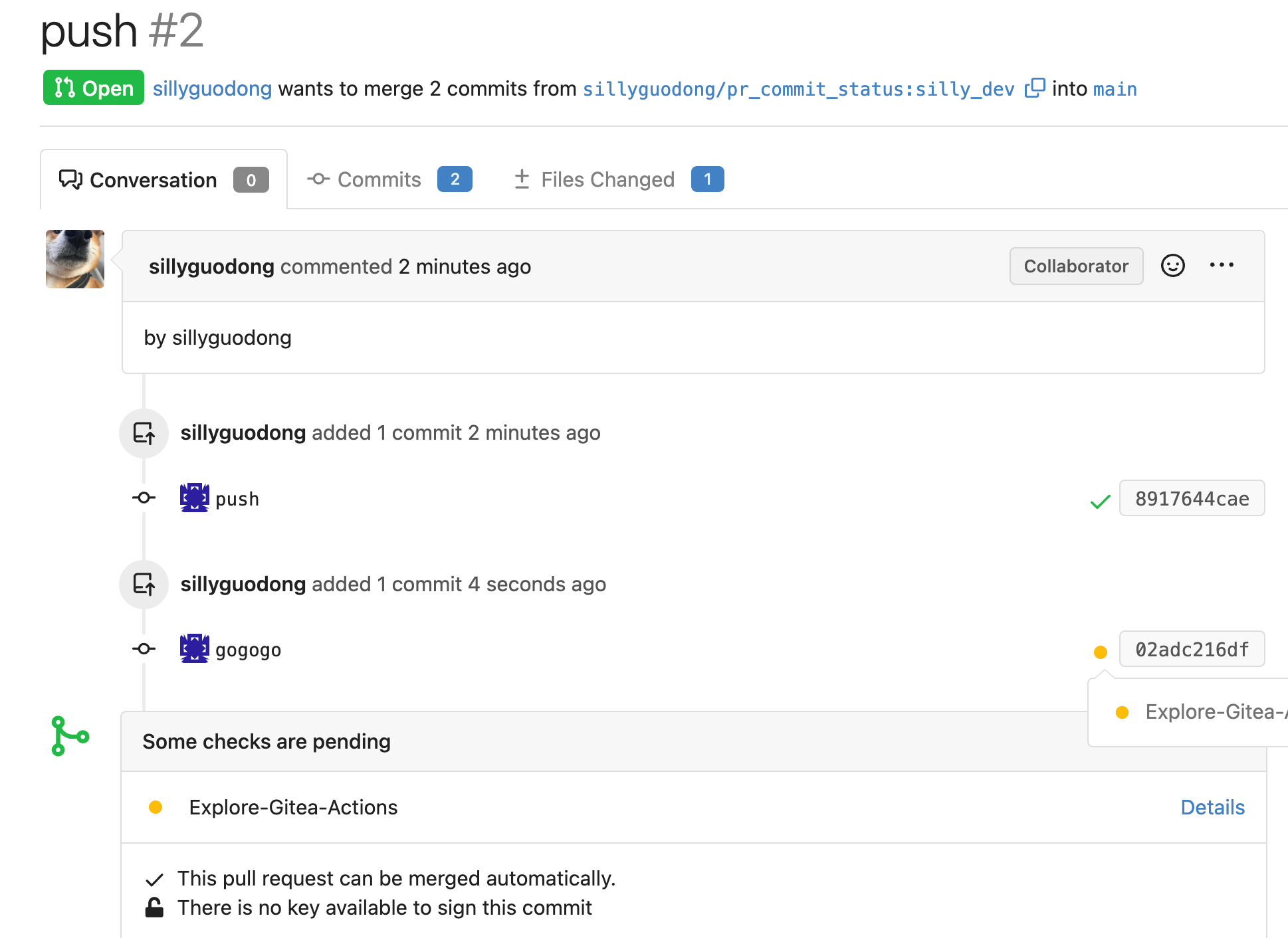
Workflows triggered by pull_request_review events (approved, rejected,
comment) complete successfully but never create a commit status on the
PR. This makes them invisible in the merge checks UI, breaking any CI
gate that re-evaluates on review submission.

The commit status handler's switch statement was missing the three
review event types, so they fell through to the default case which
returned empty strings. Additionally, review events use
PullRequestPayload but IsPullRequest() returns false for them (Event()
returns "pull_request_approved" etc. instead of "pull_request"), so
GetPullRequestEventPayload() refuses to parse their payload.

Signed-off-by: Jörg Thalheim <joerg@thalheim.io>
Co-authored-by: silverwind <me@silverwind.io>
Fix#35781, #27472
The PR will not correct the wrong numbers automatically.
There is a cron task `check_repo_stats` which will be run when Gitea
start or midnight. It will correct the numbers.
Misspell 0.5.0 supports passing a csv file to extend the list of
misspellings, so I added some common ones from the codebase. There is at
least one typo in a API response so we need to decided whether to revert
that and then likely remove the dict entry.
Follow #29468
1. Interpolate runs-on with variables when scheduling tasks.
2. The `GetVariablesOfRun` function will check if the `Repo` of the run
is nil.

---------

Co-authored-by: Giteabot <teabot@gitea.io>
Fix#28157
This PR fix the possible bugs about actions schedule.
## The Changes
- Move `UpdateRepositoryUnit` and `SetRepoDefaultBranch` from models to
service layer
- Remove schedules plan from database and cancel waiting & running
schedules tasks in this repository when actions unit has been disabled
or global disabled.
- Remove schedules plan from database and cancel waiting & running
schedules tasks in this repository when default branch changed.
- cancel running jobs if the event is push
- Add a new function `CancelRunningJobs` to cancel all running jobs of a
run
- Update `FindRunOptions` struct to include `Ref` field and update its
condition in `toConds` function
- Implement auto cancellation of running jobs in the same workflow in
`notify` function

related task: https://github.com/go-gitea/gitea/pull/22751/

---------

Signed-off-by: Bo-Yi Wu <appleboy.tw@gmail.com>
Signed-off-by: appleboy <appleboy.tw@gmail.com>
Co-authored-by: Jason Song <i@wolfogre.com>
Co-authored-by: delvh <dev.lh@web.de>
Close#24544
Changes:
- Create `action_tasks_version` table to store the latest version of
each scope (global, org and repo).
- When a job with the status of `waiting` is created, the tasks version
of the scopes it belongs to will increase.
- When the status of a job already in the database is updated to
`waiting`, the tasks version of the scopes it belongs to will increase.
- On Gitea side, in `FeatchTask()`, will try to query the
`action_tasks_version` record of the scope of the runner that call
`FetchTask()`. If the record does not exist, will insert a row. Then,
Gitea will compare the version passed from runner to Gitea with the
version in database, if inconsistent, try pick task. Gitea always
returns the latest version from database to the runner.
Related:
- Protocol: https://gitea.com/gitea/actions-proto-def/pulls/10
- Runner: https://gitea.com/gitea/act_runner/pulls/219
Fix#25088
This PR adds the support for
[`pull_request_target`](https://docs.github.com/en/actions/using-workflows/events-that-trigger-workflows#pull_request_target)
workflow trigger. `pull_request_target` is similar to `pull_request`,
but the workflow triggered by the `pull_request_target` event runs in
the context of the base branch of the pull request rather than the head
branch. Since the workflow from the base is considered trusted, it can
access the secrets and doesn't need approvals to run.
This PR replaces all string refName as a type `git.RefName` to make the
code more maintainable.
Fix#15367
Replaces #23070
It also fixed a bug that tags are not sync because `git remote --prune
origin` will not remove local tags if remote removed.
We in fact should use `git fetch --prune --tags origin` but not `git
remote update origin` to do the sync.
Some answer from ChatGPT as ref.
> If the git fetch --prune --tags command is not working as expected,
there could be a few reasons why. Here are a few things to check:
>
>Make sure that you have the latest version of Git installed on your
system. You can check the version by running git --version in your
terminal. If you have an outdated version, try updating Git and see if
that resolves the issue.
>
>Check that your Git repository is properly configured to track the
remote repository's tags. You can check this by running git config
--get-all remote.origin.fetch and verifying that it includes
+refs/tags/*:refs/tags/*. If it does not, you can add it by running git
config --add remote.origin.fetch "+refs/tags/*:refs/tags/*".
>
>Verify that the tags you are trying to prune actually exist on the
remote repository. You can do this by running git ls-remote --tags
origin to list all the tags on the remote repository.
>
>Check if any local tags have been created that match the names of tags
on the remote repository. If so, these local tags may be preventing the
git fetch --prune --tags command from working properly. You can delete
local tags using the git tag -d command.
---------
Co-authored-by: delvh <dev.lh@web.de>
There is no fork concept in agit flow, anyone with read permission can
push `refs/for/<target-branch>/<topic-branch>` to the repo. So we should
treat it as a fork pull request because it may be from an untrusted
user.
The name of the job or step comes from the workflow file, while the name
of the runner comes from its registration. If the strings used for these
names are too long, they could cause db issues.